


Conquering Ipsay Pass - The Lares Trek in the Peruvian Andes
- gaylemabery
- Sep 8, 2025
- 7 min read
Updated: Oct 3, 2025
Today is the day we’ve been training for all summer! After months of preparation in the San Juan Mountains of Colorado, we will finally attempt the altitude that had once felt more dream than destination.
After yesterday’s trek (click here for that recap) we had a good night of sleep and a 6:00 am wake up with Rolando and Saul at our tent door with coffee for Scott and tea for Gayle. Is this for real? In all that dreaming, we weren’t picturing this as our wake up on the day of our big summit!

It was a cloudy morning, with the threat of rain looming. We had breakfast at 6:30 am which included hot oatmeal, toast, scrambled eggs and bacon. It felt like just the right balance to give us the energy we’d need for a long day of hiking. Today’s hike would be about 9 miles, with Ipsay Pass (Ipsay Qassa) right in the middle.
We started the hike at 7:30 am and were a little worried when Saul broke out both of his hiking poles. Yesterday, he walked with one pole (and probably didn’t need it). Today, he said, he’d use them for the steepness. We gave a collective “gulp” at the stark reminder of what we were in for!

We walked a short distance through town, and then started the ascent into a foggy unknown. Almost immediately, we started seeing children, decked out in their bright red traditional clothes, coming out of the fog of the mountains to start their school day. We’d packed candy and snacks just for this purpose, and they seemed to know we’d have treats for them.
The rain started soon after we began, so we got out our ponchos and continued the hike.

We’d been hiking just over an hour, and were on a ridge at about 13,500’ when we saw a home below us. Far in the distance, we could see a Quechua woman working in the fields. In the door of the house stood two little children (I’m guessing 1 and 3 years old). As we gazed down, the older child started up the hill (probably 200 yards) towards us. Saul greeted him in Quechua and we immediately broke out the candy. We didn’t get any smiles, but he clearly wasn’t afraid of us either. He didn’t seem bothered by the cold weather in his traditional sandals, but his chapped cheeks certainly told the story of living in this harsh environment. Scott tried to give him “knuckles” to say goodbye, but he wasn’t familiar with that custom. We said adios, and started back up the trail, with him watching for a few minutes then starting back down the hill to his house.

We had passed quite a few houses up here in the highlands. It was amazing to see the extensive farming at over 13,000 feet. While they do get snow (as evidenced by our photos!), it is usually a dusting and it melts off rather quickly. Because of the proximity to the equator, the temperature fluctuations re not very extreme.
There is no electricity, and the families used candlelight at night to see. As Saul noted, that wasn’t such a hardship, because they usually go to sleep as soon as it’s dark, and get up at first light. Even at that, though, government provided solar panels are now affixed to several of the roofs up here. This allows the children light to work on homework at night, a luxury they didn’t previously have.

What led these people to live up here in the highlands? When the Spanish conquistadors came in the 15th century and were conquering the Incas, many people fled Cusco toward the jungles and the Amazon. Some hardy souls fled to the high mountains. Those that went to lowlands and jungle were conquered or got small pox, but the people in the highlands survived.
At about 13,800’ the rain turned to snow. We’d been climbing about an hour and a half, and we could definitely feel the altitude. Gayle started getting a slight headache at about 13,500’ but a healthy dose of electrolytes helped almost immediately. She probably wasn’t drinking enough given the cold temperatures (she drinks a lot when it’s hot). We had passed numerous fields planted with crops (mainly potatoes), and had seen more alpacas than we thought were possible.
Our chefs and the horse crew had started packing up the camp when we left for the hike. Although they’d been able to drive a vehicle to that first campsite, they’d be hiking the same trail we did for the rest of the day. We could see Ipsay Pass in the distance and the snow was falling steadily now. We stopped to catch our breath, and then saw our crew coming up the trail in the distance. They caught us just before the hard push up the pass began, with the horses and horsemen in the lead (and a couple of straggling horses that left one of the farms and started following them!) and Rolando and Saul hiking behind. They moved on, as they were on a mission to get ahead of us and set up lunch. These guys are incredible!
On we trudged, taking more breaks, and dodging llamas along the way. We quit checking the altitude after we passed 14,058, as we knew at that point we were higher than our highest training hike (Handies Peak in Colorado).
Saul was kind enough to film us cresting Ipsay Pass. Yes, the air was thin, and each step and breath seemed a conscious effort up there at the summit, but there was a real sense of triumph! Surrounded by the jagged peaks of the Andes, kissed by snow and silence, we looked out over a world that few ever reach—and for a moment, the hard work, the cold, the aching lungs all vanished, replaced by a quiet pride. We had made it! All that training paid off!

We didn’t stay on the top of the pass long. It was slow going on the descent. The snowy, wet conditions made everything slippery, so footing placement was crucial.
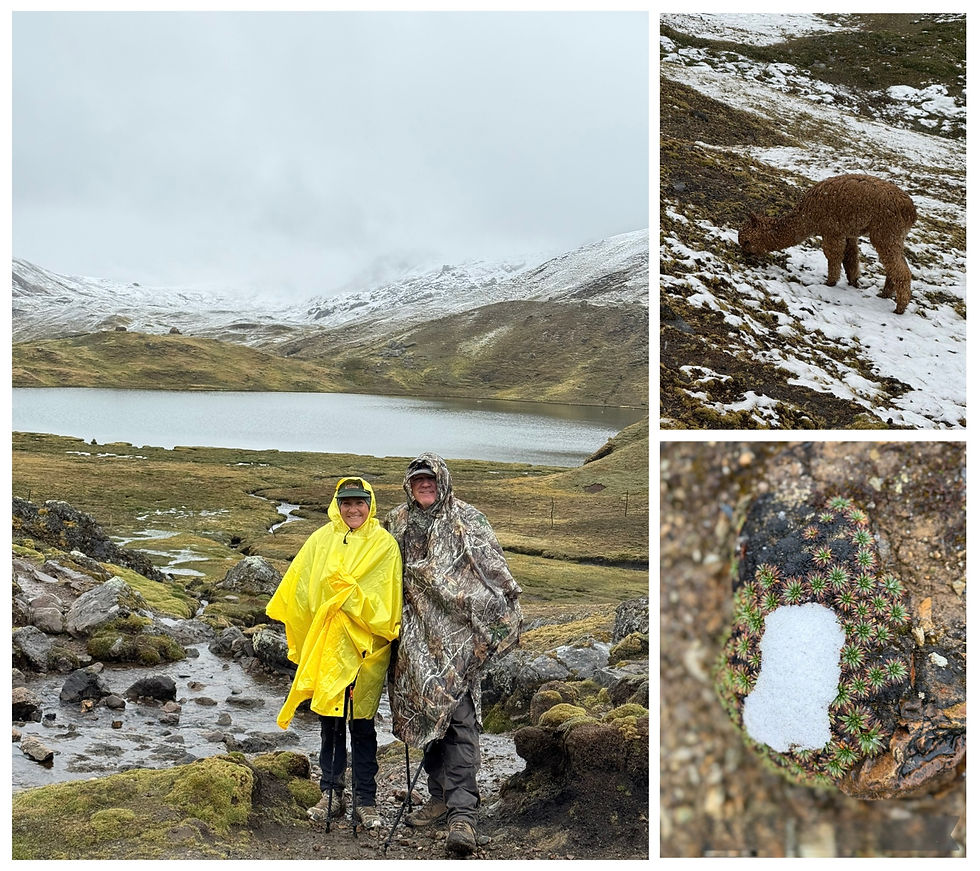
About 30 minutes after cresting the pass, we came upon Ipsay Lake. It certainly must be a stunning sight at any time, but the added snowfall made it extra beautiful. Saul and Gayle had fallen back while looking at some of the small details along the trail. That gave Scott about 5 minutes overlooking the lake on his own. When we talked about it a few days later, he said he had an overpowering spiritual feeling at that moment. We would both have those moments in the trek. The Incan spirit seems very strong here.

We passed many more alpacas and several highlands homesites on the way down from the pass. It finally quit snowing at about 14,200 feet.

About an hour after the summit, we came upon our lunch site. Another charming site rented from Quechua farmers. The elevation here was still high, at 14,020’.

We finally felt like we truly earned the fine meal that was prepared for us.
Lunch was chicken strips appetizer; creamed corn with veggie soup; beef tips, quinoa, and mashed potato as the main dish. We were hungry and cold, and loved every bite!

After lunch, we headed down the mountain towards the village of Patacancha. School was letting out as we arrived at around 2:30pm and we came upon a charming group of 3 boys and a girl.
Roxanna was dancing in the road, and the two oldest boys were playing marbles. The youngest, who stuck close to Roxanna, was literally bouncing with happiness when we gave them candy and snacks. They all lit up when we pulled out a piece of fruit, and Roxanna got that special treat!

Roxanna and I swapped hats for a few moments, and you can see her with my Girls on Fire (GOF) hat. GOF was founded by our daughter Morgan, and empowers woman to experience the outdoors. Little Roxanna certainly embodies the essence of GOF!
We talked with the kids for quite some time and started moving along our way when the rest of our horse crew showed up. Scott gave all four kids “knuckles” and they happily responded back. That made his heart warm, and made him miss our grandsons even more! While the kids giggled and called “Hasta Manana” we made our way down to our campsite.
The homestead we camped at this evening has truly made a business of catering to tourists. They had 5 small cabins on the site, 4 larger homestay rooms, with a cooking kitchen and a dining hall. The bathroom even had a hand washing sink and a shower (cold water only…we skipped that!).
Our tents are pitched on the terraces, and there are no other guests at this time. The elevation is 13,000 feet. As I noted previously, while we’d hiked to 14,000 feet before, we’d never stayed at this high an elevation for so long. By tomorrow morning when we start the hike down, we’ll have been above 13,000 feet for about 24 hours, and above 12,500 feet for 40 hours. Those elevations don’t impact the locals, but it can really do a number on folks whose bodies aren’t accustomed to it. We were feeling pretty proud having summitted 14,700’ and hiked 9 miles at high elevation without a problem!
Horseman Walter left us after camp was set up because there wasn’t enough grazing here for the horses. He would hike back the way we had come (and drop off the one stray horse that stayed with us since this morning!). As this village is serviceable by vehicles, all of our gear will be taken by car tomorrow.

In celebration of our big day, the owner brought out small cups of beer to Scott and the guys (Gayle was resting in the tent). The tradition here is to tip a tiny bit of beer on the ground before drinking, which is an offering to give thanks to Mother Earth.
Patacancha and the nearby village of Willoq are recognized for preserving their traditional Andean culture, their traditional textile weaving, and are considered to be a living heritage of the Inca people. These communities have preserved their cultural traditions for over 500 years.
At camp, we had our traditional tea time at 4pm and Rolando made fried cheese wontons and popcorn with coffee and tea. Later, for dinner, we had appetizers, soup and an amazing chicken chow mein. Then Rolando brought out a special cake he had baked in celebration of our last night on the trek!

The clouds had cleared, making the night at 13,000’ extra chilly. With full tummies and our hot water bottles in hand, we snuggled into our sleeping bags, using an extra sleeping bag liner for a little extra warmth. Just before bed, we looked up in the sky, and saw the Southern Cross for the first time! Scorpio sat nearby. It was a beautiful scene!
To learn about the challenges of our third and final day on the Lares Trek, go to our next blog.


Comments