


Lares Trek in the Peruvian Andes - Day 1
- gaylemabery
- Sep 7, 2025
- 8 min read
Updated: Oct 3, 2025
After several days touring and acclimating to the altitude in Cusco and the Sacred Valley of the Incas, our trekking journey was about to begin! If you are interested in the 3 days we spent in Peru before the trek, you can find the previous blog posts here.
We spent yesterday with our guide, Saul, and he gave us our duffle bags for the trek. We had travelled carry-on to Peru, with each of us having a carry-on suitcase and a backpack. The night before the trek, we sorted our gear. Anything we needed while actually hiking on the trail (snacks, gloves, clothing layers, water, rain ponchos, etc.) went in our backpacks. All the extra things we wanted at camp (sleeping clothes, heavier layers, toiletries, etc.) was packed in the orange duffle bags and would be carried by porters to the daily campsites. Everything else we brought that was for the touring phase of our trip would stay in our suitcases and be waiting at our hotel when we finished the trek. I should note, our trekking package was somewhat “all inclusive”, so Explore Inca provided our tents, sleeping bags, sleeping cots/pads and meals. We only had to bring our personal items.

Our guide Saul and van driver picked us up from the Tierra Via Hotel in Urumbamba at 6am. Riding along with us were Chef Rolando and his assistant Saul (yes, we had 2 Saul’s!) who would be part of our trek team. We had a 2 1/2 hour drive through the Andes to get to the Hot Springs in Lares where our trip would begin.
Our first stop along the way was at a busy market in Yucay where guide Saul hopped out to buy some coca leaves to share with rural men and women we met along the trek. (See our blog post on “Exploring Local Culture in Cusco and the Sacred Valley” for the importance of coca leaves in this culture.). After that brief stop, we headed up a long, narrow (1 1/2 lanes at most), winding road through the Andes to the tiny town of Lares. Amazingly, Gayle’s car sickness didn’t kick in on the road. It must have been the beautiful scenery that kept her from thinking of it. Here’s a video of the road:
Along the way, we passed a public bus (really the size of a 15-passenger van) that apparently travels this road every hour, providing transportation services from the highland communities to the Sacred Valley. Quite impressive for this rural area!
We topped out at a 14,500’ pass before beginning the descent into Lares. In the town, we bought candy to share with the children we would meet while trekking in the highlands.

We arrived at the Lares Hot Springs where we had a pre-hike soak before officially beginning the trek. Our chefs didn’t join us for the soak, as they were getting a head start to go to our lunch rendezvous spot. The water felt great, and we lamented that we were doing the soak before the hike instead of after! There was a mix of trekkers and locals soaking, and because it was a weekday morning, it wasn’t crowded at all.

After about 90-minutes, we finished the soak, changed back into our hiking gear, and were ready to start our adventure! The Lares Trek actually starts right from the hot springs, at an elevation of 10,700 feet. We crossed the bridge and were officially on our way at 10:20 am.
We had hiked about a mile down the trail when we saw a man walking towards us. He was about 200 yards ahead of us. He was dressed in traditional Quechua clothes and was waving his arms to get our attention. Saul just kept walking, but when he started waving a second time, we asked Saul if he thought the man needed help. Saul wasn’t sure, and as we continued walking towards each other, the man finally sat on a rock next to the trail. Here was our approach:
As it turned out, the man was Machula Vargas, and he was our lead horseman for the trek. He enthusiastically introduced himself, and it was clear from his demeanor that he’d been chewing coca leaves all morning! We still don’t know why he hiked down the trail to meet us, as he had the horse tied up back up the trail, and we all had to head that way to get to our lunch stop. Perhaps the energy from the coca made him eager to walk!
Machula followed along the trail behind us, sometimes conversing with Saul, and always smiling and dancing if we turned toward him (especially if we had a camera pointed at him)! We picked up his horse, and continued hiking towards our lunch spot. You might notice in the photo below that Machula wore traditional Quechua sandals. Most of the people in the highlands do so. They are tough people with very tough feet!

Our destination today was the town of Huacahuasi, at an elevation of 12,500’. While we’d previously hiked at that elevation and higher, we’d never camped that high. The total trek was to be 5-6 miles, with an elevation gain of about 2,000 feet. It was a good way to start the trek! We hadn’t hiked in about 10 days, so 5-6 miles uphill got our hearts pumping, but with the mild grade, it was very doable.
We stopped for lunch about 2.5 miles into the hike and got our first taste of what meals would be like on the trek. Our outfitters had rented space from a local family who had a building on their property specifically designed for trekkers. It was a two-room building, with one room serving as a kitchen space, and the other room a dining room. Rolando (in full chef’s attire) and Saul were cooking away when we arrived. We had no idea we’d have this kind of amenities for meals.
We had originally signed up for a group trek, but last minute changes by Explore Inca converted us to their private tour package. We were a bit embarrassed at the treatment for just the two of us, but appreciated all the effort by our trek crew!
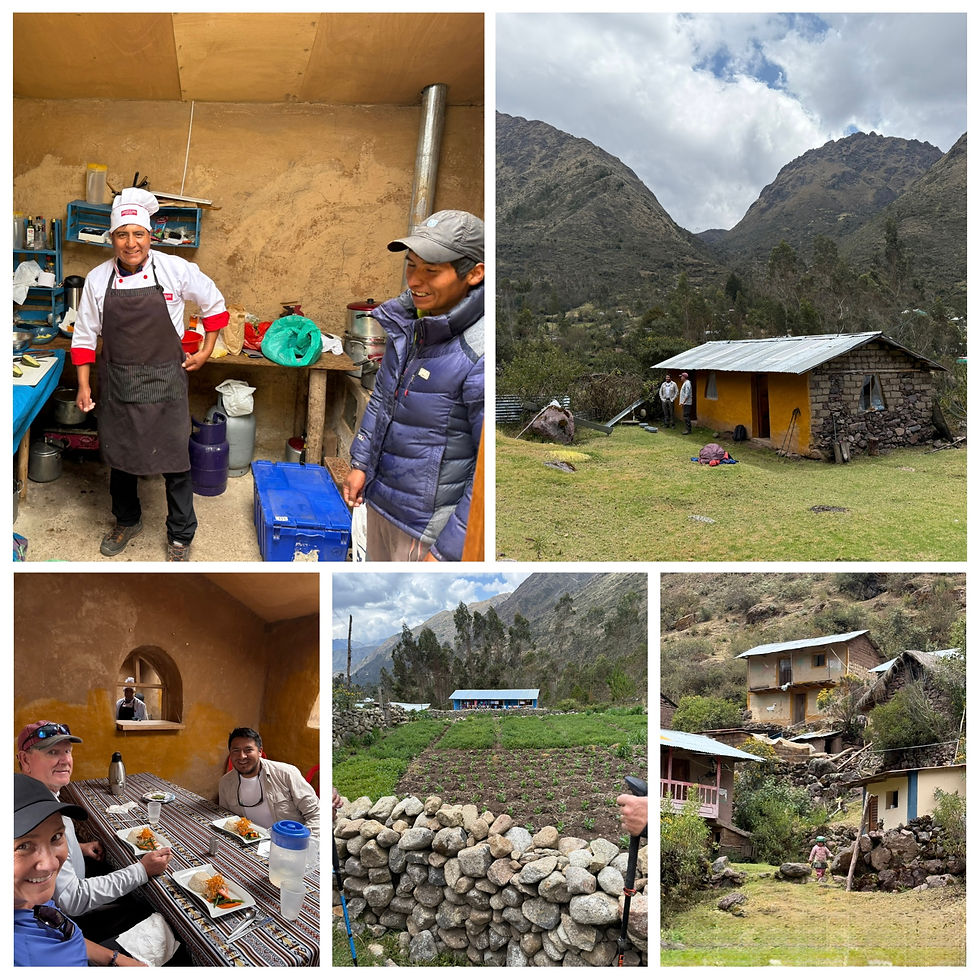
Not only were the facilities a surprise, but our menu was unbelievable! We had a 3-course lunch, with guacamole and chips as an appetizer, a delicious soup, and trout (from the local river) with rice and local fresh veggies. Everything was made from local fresh ingredients…no processed food from this group! It was delicious, and the presentation was as good as any 5-star restaurant!

After lunch, we got to meet the family who was hosting us. Like many of the homes here, it’s a multi-generational living situation. Today, little Sarai was being taken care of by her grandparents Wensislau and Justina Puma. Justina was always busy making thread from alpaca wool, and she had a variety of items for sale. Gayle bought some alpaca gloves and Scott bought a wool hat. Both items would come in handy on the trek. Justina was very sweet, and insisted we take pictures together. Sarai was still a little wary of strangers, but she was happy with the candy we gave her!

We continued on the trek, walking along flowing creeks and through rural farmland. Up in the high country, our understanding is there isn’t really land ownership. The land is “community” land, and different families have homesteaded it (sometimes hundreds of years ago). The land passes to the next generation, and if someone stops farming it or abandons a house, a new person or family can take possession of it. There are trails everywhere (sometimes made by people, sometimes by llamas and alpacas), and the locals seemed quite used to having people walking through their lands at any given time.

In addition to acres upon acres of crop lands, we also saw quite a number of greenhouses on people’s farms. According to Saul, the local governments provided assistance for local families to install greenhouses to help combat poor nutrition in the region.
Today we also learned the common Quechua greeting, “Allinllachu”, which basically means “hello, how are you doing today, have a good day”. Most people in the highlands learned Quechua as their primary language and were taught Spanish (which is the official language in Peru) in school.
We had another funny experience with Machula late into the hike. We were walking by a field and a group of sheep were escaping through a hole in the fence. All of a sudden, Machula came running from behind us, left his horse and went running up the trail in the direction of the escaped sheep! As it turned out, they were Machula’s sheep, and he rounded them up, brought them back and made a quick repair on the fence!
We arrived at Huacahuasi at 2:30 pm, and saw two groups of little boys (one in the churchyard and one a bridge) playing marbles. They were all dressed in traditional Quechua clothing, and had just gotten out of school. We’d see other boys playing marbles later in the trek It is a common pastime for young boys, and they are really good at it!

On arrival at our campsite, which was again rented from a local family, we found our tent all set up, with our orange gear bags placed neatly inside. A beautiful Peruvian rug was laid out on the floor. There was a toilet room nearby that we would share with our crew. Warm bowls of water with soap were set out so we could wash our hands and do any clean up we wanted.
Again, this family had constructed a building just to rent out to trekking outfitters. There was a designated kitchen space, and a separate dining room. This truly is a great way for the trekking companies to support the local economy.
We were right in the town, with the school’s futball field across the street and three boys were hard at play. Dogs, llamas, alpacas, chickens and horses could be found around almost every corner. As we’ve found in almost every place in Peru, there is clearly poverty, but there is a true sense of pride and things are generally very tidy.
After we’d toured our camp, Rolando and Saul told us to relax, and that we’d have tea time at 4:00 pm. See our blog on Culture and Traditions for more about Tea Time.

During our downtime, we also met Walter, who was the second horseman that would be on the trek with us. In total, we’d have our guide Saul, a chef and his assistant, and two horseman. It’s quite a crew!
Dinner was served at 6:30 pm. The sun had set by then, and the chill of the 12,500’ mountain elevation was setting in. The cream of pumpkin with spinach soup served with garlic bread was just the ticket to warm us up. Our main course was chicken with quiche and vegetables, and we had chocolate pudding with banana for dessert. We are certainly going to be well fed on this journey.

After dinner, Saul briefed us on tomorrow’s trek. It would be the hardest day of the hike, topping out at almost 15,000 feet. We were ready for a good night of sleep before our big day. Just as we were heading to our tent, Rolando presented us each with hot water bottles to sleep with! The pleasure of that warm bottle down on our toes in the sleeping bags was almost indescribable! This may become a new staple in our camping gear bags!!

Our -20 degree sleeping bags were warm, and the sleeping pads cozy. All those dogs we’d seen during the day had jobs to do at night. They are guard dogs, who protect the alpacas, llamas, sheep and chickens from foxes and pumas at night. It took some getting used to the fits of barking during the night, but we both got a pretty good night’s sleep. We would need it, as tomorrow would be quite the challenge.
To see our post about tomorrow’s trek over Ipsay Pass, go here.


Comments